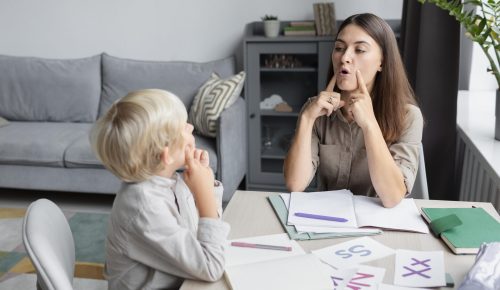

“Should we stop speaking our language at home so our child learns English faster?” “Will two languages confuse my child?” “The doctor told us to only use English. Is that right?”
We hear questions like these from families every week. Many parents have been told, by a relative, a teacher or even a health professional, that speaking two languages will slow their child down. It’s an understandable worry, and it comes from a good place. Every parent wants their child to do well at school.
The short answer is no, you don’t need to drop your home language. In most cases, keeping it is one of the best things you can do for your child. Here’s why, along with what bilingual development actually looks like and when it’s a good idea to get some advice.
Two languages don’t cause a language delay
This is the big one, so we’ll start here. Learning two languages does not cause a speech or language delay. Children all over the world grow up with two, three or more languages, and for most of human history that’s been completely normal.
Bilingual children usually reach the main milestones at around the same ages as children learning one language. They say their first words at around 12 months and start putting two words together at around 2. The difference is that their words are spread across two languages.
So if you only count your child’s English words, they might look a bit behind. But if you count all the words they know across both languages, they’re usually right on track. A child might use the home language word for water with family and say “milk” at childcare, and both of those count.
What bilingual development looks like
Mixing languages is normal
Lots of parents worry when their child mixes two languages in one sentence, like starting a sentence in English and finishing it in the home language. This is called code-mixing, and it’s not a sign of confusion. Adults who speak two languages do it all the time. Children use whichever word comes to mind first, or whichever one they know best for that thing.
As they get older, children get better at keeping their languages separate depending on who they’re talking to. Even quite young children will often switch to English for their English-speaking teacher and back to the home language for grandma.
One language is often stronger than the other
It’s very common for one language to be stronger, and for that to change over time. A child who spends most of their day at home with family might be stronger in the home language. Once they start childcare or school, English often catches up and overtakes it.
Children also tend to learn words for different parts of life in different languages. They might know all their food and family words in the home language and all their colours, shapes and school words in English. That’s just a reflection of where they hear each language.
The “quiet period”
Children who speak one language at home and then start learning English at childcare or school often go through a quiet stage. They might say very little in English for a while, sometimes a few weeks and sometimes several months. During this time they’re listening, working out how the new language works and building up their understanding.
This is a normal part of learning a second language. It’s different from a child who isn’t talking much in either language, which we’ll come back to further down.
English takes time
Children usually pick up everyday “playground” English within a year or two. The more complex language used in the classroom, like explaining, comparing and understanding written instructions, takes a lot longer to develop. It’s common for this to take several years.
So a child who chats happily in English but struggles with more complex classroom language may simply still be learning. That’s something teachers and speech pathologists need to keep in mind before deciding a child has a language difficulty.
Why keeping your home language matters
A strong first language helps the second one
The skills a child builds in their first language carry over into English. If they understand how stories work, know lots of words for things and can explain their ideas in their home language, they have a strong base to build English on. Switching to English at home doesn’t speed this up. Often it just means the child gets less rich language overall.
You talk best in the language you know best
When parents speak the language they’re most comfortable in, they tend to talk more, use a wider range of words, tell stories, joke around and explain things in detail. That’s exactly the kind of talk that helps children’s language grow.
If a parent who isn’t confident in English switches to it for their child’s sake, the conversation often gets simpler and shorter. The child ends up hearing less, not more.
It keeps families connected
Language is how children talk to their grandparents, understand family stories and feel part of their culture and community. When a child loses their home language, it can become really hard for them to talk with older relatives, and that’s a loss that’s very hard to undo later.
There are other benefits too
Being bilingual is a real skill. It opens doors for travel, work and friendships, and it lets children move between different parts of their world with confidence.
What about children with a disability or language difficulty?
Families of children with autism, developmental language disorder (DLD), Down syndrome or other developmental differences are often told to stick to one language to “make it easier”. The research doesn’t back this up.
Children with language difficulties can learn two languages. Their difficulties will usually show up in both languages, but speaking two languages doesn’t make the underlying difficulty worse, and keeping the home language doesn’t hold back their English.
For many of these children, the home language is where their strongest relationships are. Taking it away can mean losing important connections with the people who know them best. If your child has a disability or diagnosis, a speech pathologist can help you work out a plan that supports both languages in a way that fits your family.
When should I get advice?
Because bilingual children’s skills are split across two languages, it’s important to look at both. A true language difficulty will show up in both languages, not just in English.
It’s a good idea to speak with a speech pathologist if your child:
- isn’t using any words in either language by 18 months
- isn’t combining words in either language by around 2 and a half
- is hard to understand in their home language, even for family
- has trouble understanding what’s said to them in the home language
- has lost words or skills they used to have
- is having a lot more trouble learning English than other children with similar exposure, and you also have concerns about their home language
- has a family history of speech, language or reading difficulties
You know your child best. If something doesn’t feel right, it’s always fine to ask.
How speech pathologists assess bilingual children
Assessing a bilingual child takes a bit more care. Most standardised language tests were designed for children who speak only English, so a bilingual child’s scores on these tests can look lower than their real ability. A good assessment looks at the bigger picture.
That usually means:
- asking you lots of questions about how your child talks and understands in the home language
- finding out how much time your child spends hearing and using each language
- watching how your child plays and communicates
- working with an interpreter or a speech pathologist who speaks your language where possible
- looking at how quickly your child learns new words and skills, not just what they already know
This helps us work out whether a child is still learning English, or whether there’s an underlying language difficulty that needs support.
Tips for raising a bilingual child
- Use the language you’re most comfortable in. Your child will learn more from rich, natural talk in your strongest language than from simplified talk in English.
- There’s no one “right” system. Some families have each parent use a different language. Others use the home language at home and English when they’re out. Others mix freely. What matters most is that your child hears plenty of each language, often.
- Read together in your home language. If you can’t find books in your language, you can tell the story from the pictures in any book.
- Sing, chat and play. Nursery rhymes, songs, cooking together and everyday routines are all great chances for language.
- Give the home language a reason to exist. Children are more likely to keep using a language when they need it, like talking to grandparents, family video calls or spending time in community groups.
- Look into community language schools. Many communities run weekend classes that help children keep their home language as English becomes stronger.
- Don’t stress about mixing. If your child uses an English word in a home language sentence, just carry on the conversation and use the home language word naturally in your reply.
If your child has an NDIS plan
Children under 6 with concerns about their speech or language can often get support through the NDIS Early Childhood Approach based on evidence of a developmental delay, without needing a formal diagnosis. Call the NDIS on 1800 800 110 to be connected with your local Early Childhood Partner, or ask your current provider about a referral. If English isn’t your first language, you can ask for an interpreter through TIS National on 131 450.
The bottom line
Speaking your home language with your child won’t hold them back. It gives them a strong foundation for learning English, a deeper connection with their family and a skill that will stay with them for life.
If you have concerns about how your child is talking, the answer isn’t to drop a language. It’s to have both languages looked at by someone who understands bilingual development.
Our speech pathology team at Safe and Sound Disability works with families from all kinds of language backgrounds. If you’d like to talk about your child’s language, get in touch. We’re always happy to help.