
“He still says ‘tup’ instead of ‘cup’, is that something to worry about?” This comes up in almost every intake we do, and it’s a fair question because speech sounds don’t all develop at the same time.
Kids build their sound system in stages, and getting a sound “wrong” is often just where they’re up to, not a sign of a problem. The trick is knowing which mistakes are age-appropriate and which ones are worth a closer look.
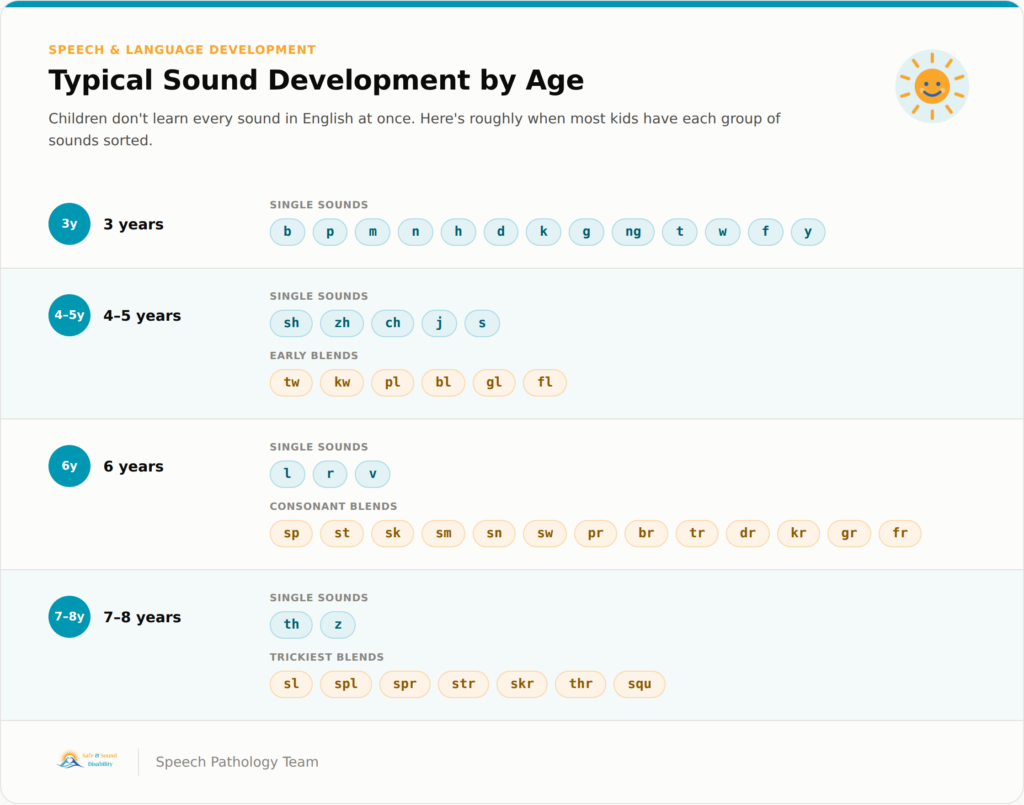
There’s also a rough guide for how much of your child’s speech a stranger should understand:
- By 2 and a half, around half
- By 4 to 5, about three-quarters
- By 6 to 7, nearly all of it, aside from the odd slip on a “th”
So a 4-year-old who still can’t say “r” properly, or drops the “s” off the front of “stop”, is usually right on track. A 4-year-old that family members struggle to understand is a different story.
Typical vs atypical speech sound errors
Not all sound errors are equal. Some are a normal part of how kids simplify words while their speech system is still developing, called phonological processes, and are expected to disappear on their own by a certain age. Others are less common and worth flagging no matter how old your child is.
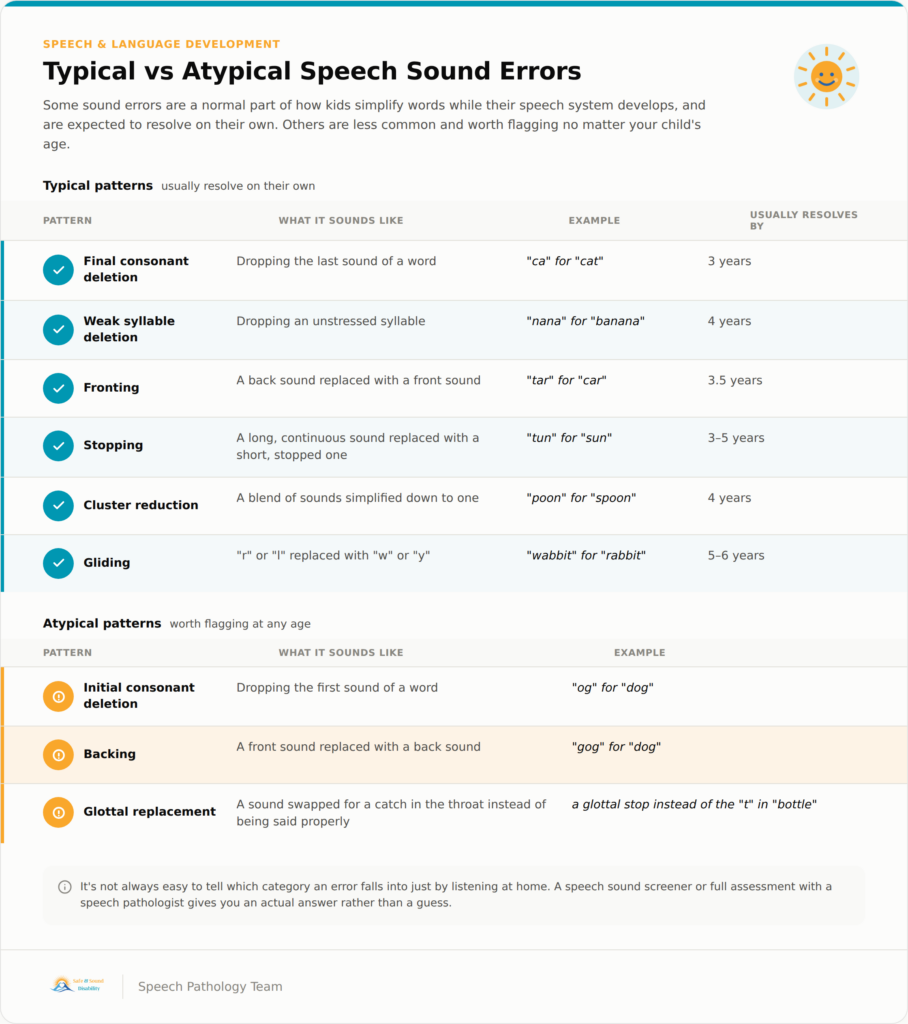
In practice, it’s not always easy to tell which category an error falls into just by listening at home. A pattern that looks like a simple mispronunciation can be part of something bigger, and something that sounds unusual can turn out to be nothing to worry about. This is exactly what a speech sound screener or a full assessment with a speech pathologist is for, so you’re working from an actual answer rather than a guess.
When to reach out for help
- Speech is hard to understand even for people who know your child well
- Errors are still there well past the age they’re expected to disappear
- Your child gets frustrated or starts avoiding talking because people don’t get what they’re saying
- There’s a history of ear infections, glue ear or any hearing concerns
- A teacher, educator or another family member has mentioned it too
None of these guarantee there’s a disorder, but they’re a good reason to get an assessment rather than wait and see.
What a speech pathologist actually does
We start by working out what’s actually going on, whether it’s a handful of individual sounds that are tricky to physically produce, or more of a pattern across lots of sounds, like always dropping the last sound off a word. The two need different approaches, so getting that distinction right matters. From there, sessions are usually play-based, with specific sounds or patterns targeted through games and repetition, and a few things to practise at home in between.
If your child has an NDIS plan
Speech sound difficulties are one of the more common reasons families come to us through NDIS early intervention funding. Children under 6 can often access support through the NDIS Early Childhood Approach based on evidence of a developmental delay, without needing a formal diagnosis first. Call the NDIS on 1800 800 110 to be connected with your local Early Childhood Partner, or ask your current provider about a referral.
The bottom line
A few mispronounced words is part of normal development, not a red flag on its own. But if something feels off, or other people keep noticing it, it’s worth getting checked.
Our speech pathology team at Safe and Sound Disability sees this kind of thing constantly, and we’re always happy to have a chat if you’re not sure whether what you’re seeing is typical. Get in touch anytime.